
The tragedy of Henry Scott Tuke – Factual
Nude male
The tragedy of Henry Scott Tuke – Factual
One of my all-time favourite male nude painters is Henry Scott Tuke (1858-1929).
He lived in the coastal town of Falmouth, Cornwall, and painted some of the most beautiful paintings of mid and older teens in innocent, rustic coastal settings.
I always assumed he was gay, but discreet, in a time where open homosexuality could get you imprisoned (Oscar Wilde and Alan Turing, to name but two prominent examples).
What made Tuke so very special, was that while his work was never overtly erotic, there was a beautiful sensuousness in the way the sunlight, the grass, the water, and the sand interacted with his models.
The young men portrayed by the models were all comfortable being nude together, in the same way as 1940s FKK nudists and Greek athletes were, giving his work a beautiful naturalness.
It is clear to me that Tuke was tremendously fond of his models. Perhaps that fondness was erotic, but I think he was in love with the Bohemian ideals of both youth and innocent nudity. Like me, I suspect he felt protective towards young men, rather than exploitative.
Tuke was painting at the same time as Wilhelm von Gloeden was taking his photographs in Taormina, on the coast of Sicily, the island just off the south-western tip of the boot of Italy. Von Gloeden’s work was clearly far more sexualised. His youths as often than not had slightly engorged penises, and posed in ways that suggested erotic intimacy, whereas Tuke’s nudes were always innocent, and genitals were rarely exposed at all.
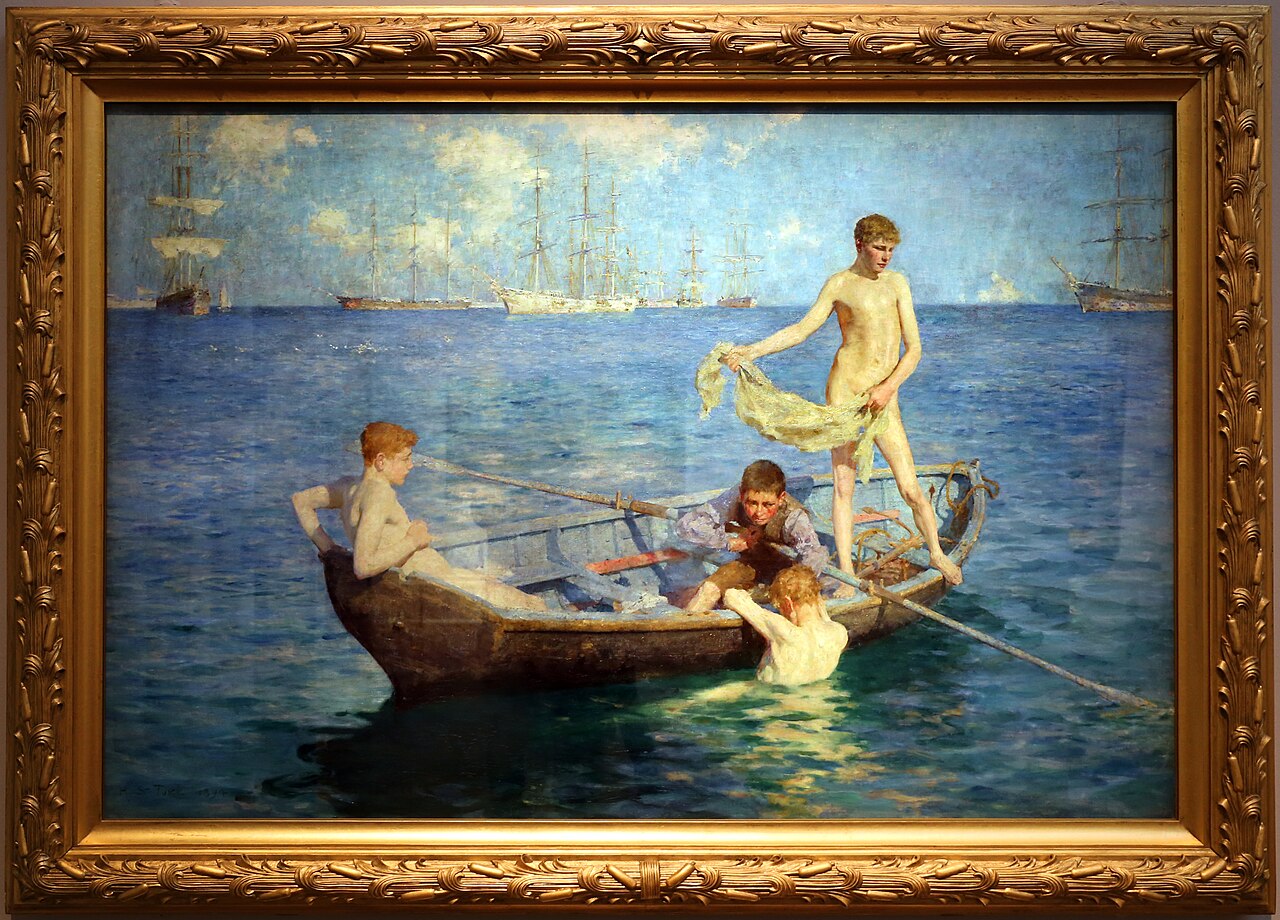
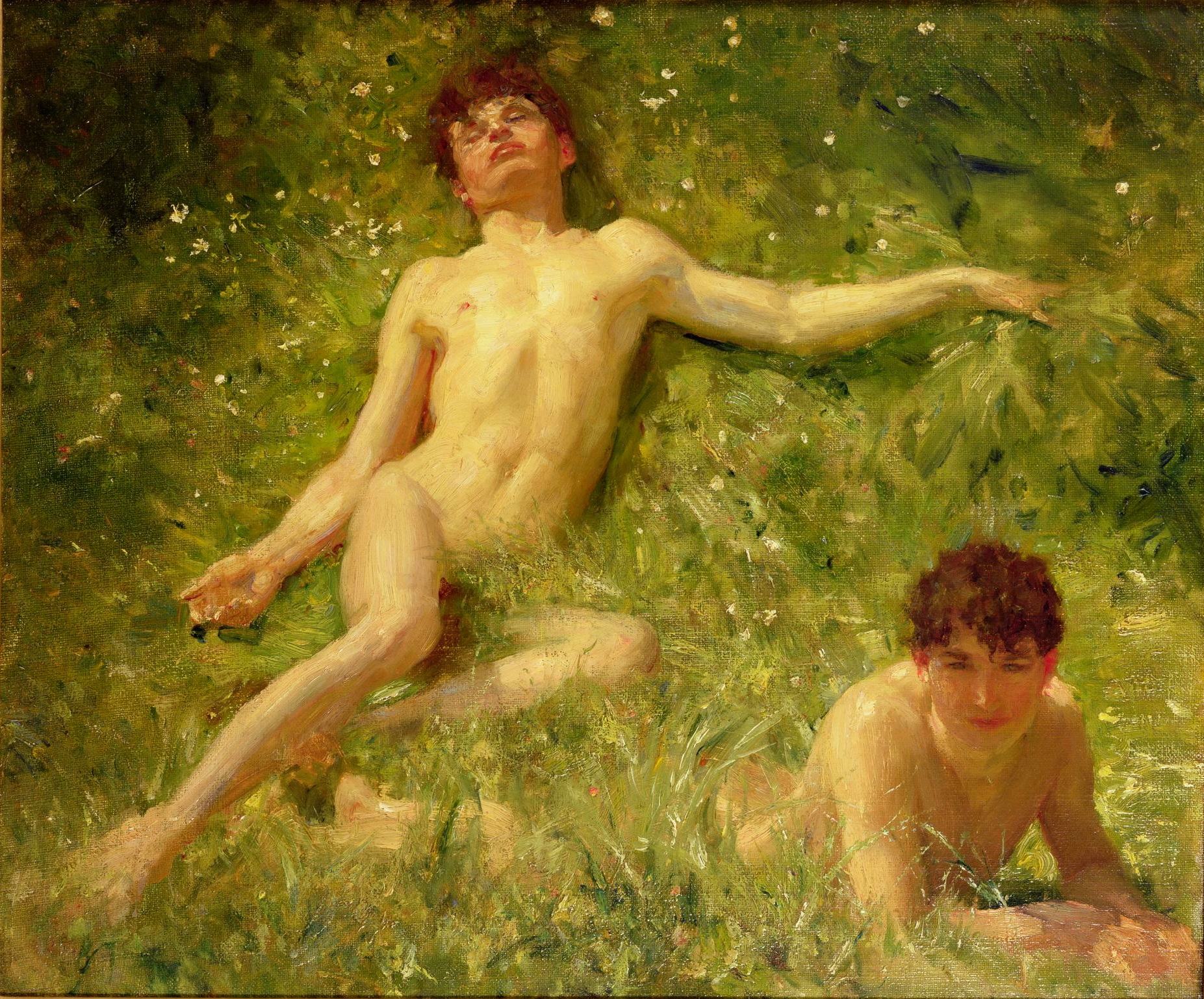
Among my favourite Tuke works are August Blue, and The Sunbathers, both of which I have clumsily recreated in 3d and included in the Classic Art gallery of this web site. But out of respect, I include here in their original form.
August Blue
The Sunbathers
There is another piece, which is perhaps less evocative, but hints at the tragedy surrounding Tuke. Now you’re probably thinking that Tuke was imprisoned for improper behaviour, but no such shadow ever befell his career.
Gleaming Waters
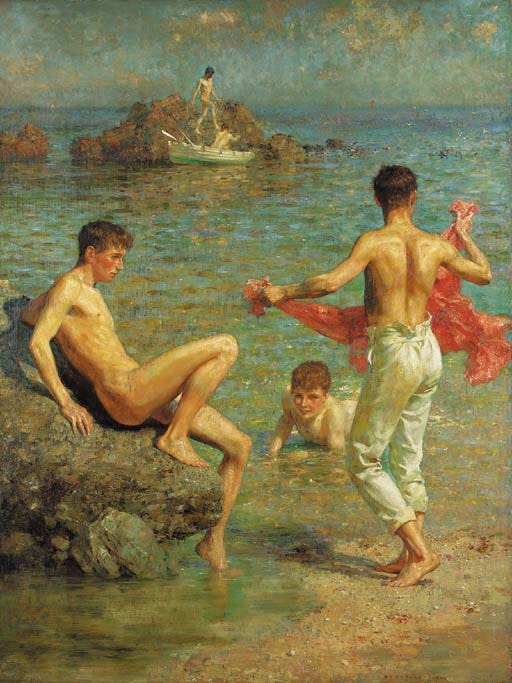
The young man on the left is a model that Tuke used often. His name was Maurice Clift (also standing in August Blue) He was lean, with light hair and a sensitive face. The model to the right holding the red shirt was Nicola Luciani, an Italian boy with tanned skin and brooding good looks.
Within a few years of this painting, both would be dead, along with multiple other Tuke models.
In 1914, Archduke Franz Ferdinand was assassinated, leading to the war that casually threw away the lives of 17 million people, including Tuke’s models. It is believed that all of them were conscripted, and many died.
Fucking ego and goddamned power struggles robbed the world of these beautiful young men, and so many other innocent souls.
Tuke was heartbroken at the death of Lucciani in 1916, and I can only imagine his sense of loss at every one of the boys who were to him, and me, the very embodiment of youthful innocence. As much as the war represented the end of an era of relative peace, their deaths must have symbolised the destruction of innocence – a theme that JRR Tolkein also reflected in his book trilogy, The Lord of the Rings.
Even now, long after those beautiful boys could possibly have lived even if the world was peaceful, it still brings a lump to my throat and a white hot rage to my heart, to think how they and so many others were robbed of their lives…
Occasionally I am inspired by stories such as this, surrounding gay artists. If you would very infrequently like to see more, please leave a comment or at least a like.
These will not count against my regular fortnightly art and story. posts

Great article! I would like to see more similar to this. I’m fascinated by the relationship (or lack thereof) between artists and their models that pose in provocative situations.
Thanks Chuck, I’m so gratified to see that this piece of history resonated with people. Tuke and his wonderful, tragic models brought so much beauty into the world!
Thank you for taking the time to write this. I was vaguely aware of his work, but not his life. This was a very moving retrospective and I’d definitely be interested in more.
I appreciate that Terry. He was an amazing artist. I think that you’d enjoy his other pieces. They’re all PG. Artist nude.
Beautiful piece. Thanks for this write-up.
Thank you Chris. Glad I’m not the only one who was moved by their story.
Thank you for that history of the artist and models. It’s absolutely tragic that these peaceful moments that captured the beauty of innocence and youth would soon turn so differently.
I agree completely David. And thank you for the comment.